Oedipus at Studio 54
On why Oedipus is worthy of the event

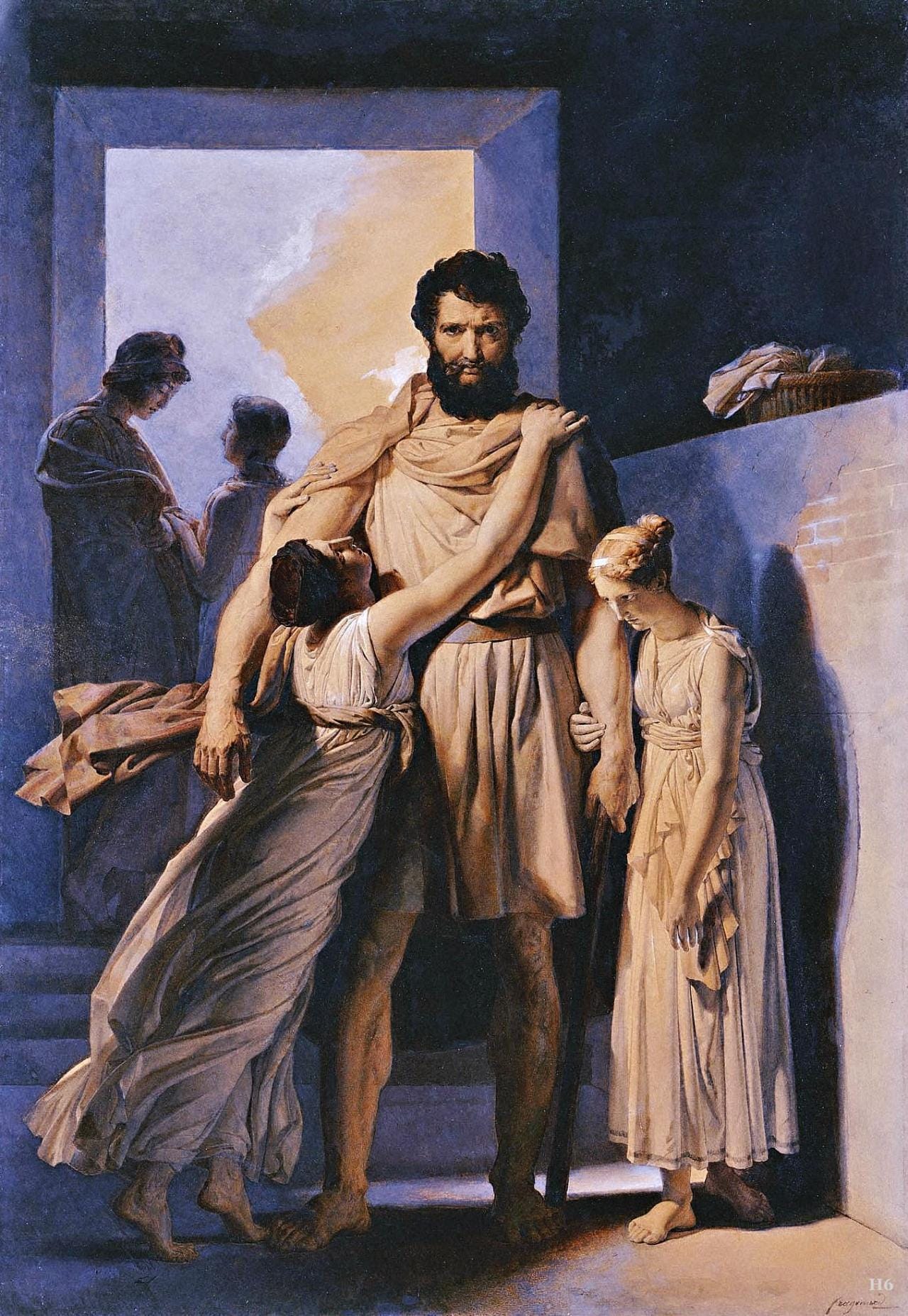
- Oedipus’s Fury. 1808. Alexandre Evariste Fragonard.
Last November, I went to the Studio 54 theater to see a performance of Oedipus starring Mark Strong as Oedpius, Lesley Manville as Jacosta, Michael Gould as Creon, and June Watson as Merope. Jordan Scowen and James Wilbraham plyed his two sons, and Phia Saban was Antigone. The performance is a modern retelling directed by Robert Icke, who is fond of reimagining the classics, including Romeo and Juliet, 1984, The Alchemist, Uncle Vanya, Hamlet, and the entirety of the Oresteia. He won the Classical Association Prize last summer.
I had wanted to see the play for so long and checked on the tickets so often that the TodayTix app was practically sending notifications to buy the seats every other day. For one, I’ve been a big fan of Mark Strong ever since I saw him in Guy Ritchie’s RocknRolla in 2008. I think he’s been severely underused in the American film world, even though I know he has done tremendous work in theater. He’s a wonderful actor and has such gravity and sincerity in his performances that it is often wasted in movies like Kingsman or Shazam. Those movies are supposed to be dumb fun and while they have made him a lot of money, seeing him in them is like watching a great soccer player playing in Saudi Arabia. I selfishly want him to play in a more challenging league, not to prove himself, but because he can’t be his best if he’s not being challenged to be at his best.
When it comes to art, it’s not necessarily that I want to always see the best plays and performances, on Broadway or the National Theatre. I’ve watched students put on plays in Detroit universities and I will be equally delighted watching friends act in their apartments, but what I want to see and know is that the people involved are giving it their all. And I don’t think those kinds of movies do that for good actors, through no fault of their own. They’re just not asked to do much. Doing too well would be a negative in those movies that don’t even take themselves seriously.
Movies like Kingsman and Shazam are always winking at the audience, reminding you that it’s silly and dumb, constantly undercutting the stakes that they want you to believe in, because they’re afraid of failure. The people responsible are afraid of making a bad movie, they don’t believe that their writing and ideas are good enough, so they have to tell and constantly remind you that it’s bad on purpose. I have no real patience for art that doesn’t believe in itself. That attempt to undercut expectations is boring to me.
I’m getting distracted!
I wanted to see Oedipus because I like Mark Strong and because Oedipus is one of my favorite classical plays, along with Antigone. I’ve read the Sophocles version as part of the Theban plays, the Seven Against Thebes trilogy by Aeschylus, the ones by Euripides, Seneca’s version, Andre Gide’s version in Two Legends, and so many different versions written by random writers on the internet.
I like Oedipus because to me, it’s the only tragedy where the protagonist realizes that they’re in a performance. It builds up like a heroic myth and right when the hero is marveling at his accomplishments, everything comes crashing down, not only from the outside even though his fate had been determined from birth, but like all the great tragedies, the fate is determined also by the character of the protagonist. It’s Oedipus who drives himself to destruction. You want to argue that he has no choice because his fate had been planned from the beginning but he takes ownership of his disaster. He refuses the idea that he was just a passive character and puts the events on himself in a way that I don’t think any other character truly does.
Oedipus is warned several times that discovering who his mother and father are will ruin him, and yet he persists, he demands to know, saying: “Nothing can make me other than I am.” And when he discovers his history and curses himself, he takes responsibility, saying that it was his hands that committed the crimes and the actions, but he also blames Apollo in the original and the gods in general in other versions. He blames them for setting him up to fail, knowing that there was no way, with his personality, with who he is, that he wouldn’t demand to know the full truth once it’s dangled in front of him. The truth doesn’t just make him an accursed man, with the murder and incest, but it unravels his belief of himself as a person. It destroys the idea that he made himself.
The Andre Gide version does a great job of giving voice to that realization and him seeing at the end that he was just a character in a story that Apollo, the gods, or God had constructed:
“God, you say. I felt strong enough to resist even God Himself. I wanted to turn away from Him, when I made off toward the Sphinx. Why? That’s what I’ve come to understand today. I was content to remain subject to God while He led me to glory, but not if He was driving me to commit a crime-and a crime whose horror He hid from me. . . . Oh, most cowardly betrayal of God, no longer to be tolerated. And now am I still God’s puppet? Has the oracle foretold what I must do next? Must I still consult it? And find out, 0 Tiresias, what the birds have to say? . . . If only I could escape from the God who envelops me, escape from myself! Something heroic, something superhuman torments me. I should like to invent some new form of unhappiness-some mad gesture to astonish you all, and astonish myself, and astonish the gods.”
After he leaves, Jacosta says:
“O unhappy Oedipus! Why did you have to know? I did what I could to stop you from tearing aside the veil that protected our happiness.”
For me, Oedipus is a monster story, as is Antigone. Monstrous in how unusual he is and how destructive that outsider quality becomes. The attribute that Oedipus has which Antigone inherits isn’t just stubbornness, but a refusal to choose safety over the truth. Or living according to their truth.
When Creon scolds Antigone for being just like her father in her destructive nature, it is because both of them are willing to tear everything down in order to live as they feel is most honest. You can see it as naive or as ridiculous, which the other characters do, but it’s because that kind of honesty is unusual. Especially when faced with death or losing a kingdom. Oedipus refuses to accept a false life, even if it costs him everything, and Antigone refuses to act any other way than as she feels is the responsible way for the ones that she loves. They don’t behave like anyone around them and no one can understand why reason doesn’t work to dissuade them.
Icke’s retelling of Oedipus Rex takes place on an election night with Oedipus set to become the new prime minister. A big stop clock on the stage counts down the hour and minutes until the election results but is also counting down to the climax of the story.
The retelling does so well at focusing on Oedipus’ value of living truthfully and honestly. Strong plays it as delicately and ferociously as needed. When one of his sons reveals that he’s gay (a twist to the story), the anger that Oedipus has isn’t about the son being queer but that he would try to hide it in fear that he wouldn’t be accepted. As long as he lived his true self, his father wouldn’t reject him. And when the truth of his life starts being revealed, first by Tiresias, then his mother, his wife, and also Creon, and everyone starts connecting the dots and begs him not to ask any further questions, assuring him that they can hide the truth of his involvement in the death of Laius, Jacosta’s first husband and the former king of Thebes, the suggestion enrages him.
They all beg him to stop. To not go further. To not know more than is necessary. None of them can understand why, on the verge of achieving his dream and becoming the prime minister, with his happy life and family. why he would risk it all by unraveling a truth that shouldn’t be. And he keeps repeating, and screaming, that he has to know. Because his idea of himself is a clear and honest one, he made and raised himself from a poor background to the top of society, and he never hid anything about who he was. To suggest that there are things that he doesn’t know about himself, is to invalidate not just his life story but his idea of himself. To reach that truth and clarity, he has to tear down everything because to go forward into a false life, a life of lies, is impossible for him. It’s not just that he refuses to do it, but he can’t.
As he says in Gide’s play:
“That crime was imposed by God. His was the ambush on my road. Before even I was born, the trap was laid, and I could not but fall into it. For either your oracle was lying or I had no possible escape. I was caught.”
The more Oedipus finds out, the more he has to know. And the more he demands to know, the more his whole world unravels. The clock in the play enhances this tension and implosion to an almost unbearable degree. Nothing about the play is new and I imagine everyone who was in the theater had read and seen the play before, but as the clock ran down and all the information started to connect and show more of the truth, the anxiety of what was to come was so high for me that I was fidgeting in my seat. It was like watching the rope holding the sword above his head slowly tear until you want him to either jump out the way or for the sword to hurry up because the slow release was too much to bear.
That tension is why going to see the play or any play or movie in person, in the theater, is so unique. You are as trapped in the story and the time of the story as the characters are. You are as vulnerable to the events as they are. You discover information along with them, even when you already know more than they do. You can’t pause or walk away. You can’t change the channel or close the book. By sitting down, you give yourself over to the experience, and when you do that, you can’t save yourself.
This giving-over to the experience is so powerful that it can make an ancient play feel new every time, regardless if the play tries to be faithful to the original or transforms it. In the play’s climax, Jacosta kills herself by shooting herself rather than hanging and when the gunshot went off, so many people in the audience gasped and put their hands to their chest. Afterwards I asked someone if that reaction was because as Americans, a gunshot sound in a public space can mean the absolute worst, or because the moment took people by surprise. The other audience member said that it wasn’t exactly a surprise because you knew what was coming, yet because we were all so invested in it, that the event suddenly felt new and shocking. By the end of the performance, I was exhausted and relieved for it to be over. In the best way possible.
When I think about Oedipus the character and the way that Strong played him, I think of what Gilles Deleuze termed as someone who is worthy of the event in his lecture series on Leibniz and the Baroque:
“One of the greatest moralists of the event is the poet Joë Bousquet. Bousquet suffered a ghastly wound that paralyzed him, and among other things, everything that he tried to say and explain was in some manner: this event, I was created to incarnate it. That is, starting from this, his problem was, in a certain manner, being worthy of the event…You indeed sense that there is a certain way to live the event as being worthy (en étant digne) of what happens to us in the good and the bad. I would say that it’s this aspect through which every event is addressed to my soul…There are whiners/wailers who are worthy of what happens, it’s even these ones that are called prophets, the prophet in his fundamental wailing. There are some who take wailing to a level of poetry, elegy, and elegy means the complaint … There are some that complain with such nobility; think of Job. Job’s complaint is worthy of the event.”
Oedipus is worthy of the event because he goes all the way. He realizes that he is a character in a story outside of his control, he sees the trap that is laid in front of him, and as everyone begs him to stop, he knows that the story can only be truly completed, if he goes all the way into the destruction of himself, his family, Thebes, and the world around him. What separates the play for me from so many others is the agency and responsibility that he takes for his actions. His refusal to live a false life but also to find a way out of the fact that he is the driving force.
Oedipus’ story doesn’t end at Thebes. At the end of Oedipus Rex, he becomes a blind wanderer, helped by Antigone, and in Oedipus at Colonus, he goes to a wilderness near Athens and Thesesus is instructed by the gods to take care of him. After his death, his grave is made sacred. I think it’s because of that worthiness, that willingness to go all the way, is why even though he is repulsive in the eyes of the other characters in the play and supposedly in Thebes, that he isn’t condemned or rejected by the gods. He plays his role perfectly, as Strong does. Both are worthy of the event.